

Rise of Olympus 1000: How Scatter Pays and Multipliers up to 1000x Change the Mythological Slot
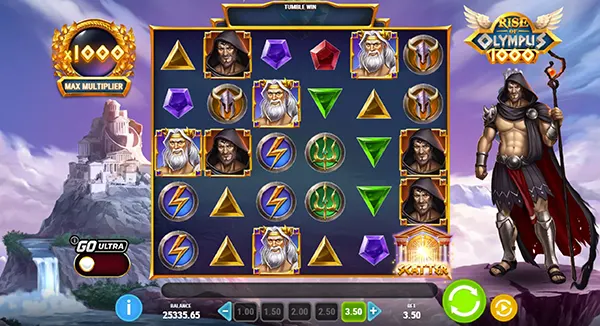
Rise of Olympus 1000, released by Play’n GO on 5 February 2026, keeps Zeus, Poseidon and Hades at the centre of the series but changes the way their powers interact with the game. Instead of relying on conventional paylines, the slot uses a 6×5 grid, Scatter Pays wins and cascading symbols. Eight or more matching symbols anywhere on the grid can form a win, while special Multiplier symbols can progress through 15 values reaching 1000x. These elements make the game less dependent on fixed symbol positions and place more emphasis on sequences of cascades, multiplier upgrades and the way values can accumulate during Free Spins.
Scatter Pays Changes How Winning Combinations Are Formed
The most immediate difference in Rise of Olympus 1000 is its Scatter Pays system. The grid contains six columns and five rows, giving 30 symbol positions on each initial spin. A paying combination requires at least eight matching symbols to appear anywhere in view. They do not need to sit next to one another or follow a line from the left side of the grid. This makes reading the screen relatively straightforward: the important question is how many matching symbols have landed rather than where a predetermined payline passes through them.
The number of matching symbols matters because payments follow the game’s paytable and rise as larger groups appear. A screen containing eight copies of one symbol can therefore qualify for a payment even when those symbols are spread across distant parts of the grid. The same principle applies to the Greek-themed higher-value symbols and the simpler lower-value icons. This arrangement gives the artwork more freedom because Zeus, Poseidon, Hades and the other thematic symbols can appear across the entire board without needing to form conventional left-to-right patterns.
Scatter Pays also changes how a player follows a round. A spin is not necessarily finished as soon as its first winning combination is evaluated. Winning symbols are removed and new symbols fall into the empty spaces, creating a cascade. If the replacements produce another combination of eight or more identical symbols, another payment can be added before the round finally ends. One stake can therefore produce several consecutive evaluations, although a cascade never guarantees that another win will follow.
Cascades Give Each Winning Round More Room to Develop
The cascade mechanism is important because it connects ordinary symbol wins with the game’s multiplier system. After a Scatter Pays combination is removed, the next set of symbols may introduce another winning group, a Multiplier symbol or both. This means the useful part of a spin is not limited to its starting layout. A round can change considerably after the first symbols disappear, particularly when several cascades occur before the board settles.
This approach creates a different rhythm from a traditional reel slot. With fixed paylines, a player can usually identify the result as soon as the reels stop. Rise of Olympus 1000 instead resolves each successful combination before rebuilding the affected parts of the grid. The process continues until no new Scatter Pays win remains. The result is visually active without requiring complicated decisions from the player, since the game handles every cascade automatically.
It is also important not to interpret a long cascade as evidence that another profitable sequence is likely to follow. The cascading presentation makes a single paid round last longer, but it does not turn previous results into a prediction of the next spin. The same applies when several large groups of symbols appear close together. Scatter Pays makes combinations possible across more positions than a fixed-line design, yet outcomes still depend on the game’s random result generation rather than patterns that a player can reliably anticipate.
Multipliers up to 1000x Become the Main Source of Escalation
Rise of Olympus 1000 has 15 individual Multiplier stages: 2x, 3x, 4x, 5x, 7x, 8x, 10x, 12x, 15x, 20x, 25x, 50x, 100x, 500x and 1000x. A Multiplier symbol can appear during a round and increase the value applied to qualifying wins. The jump from 100x to 500x and then to 1000x is particularly large, but 1000x should be understood as the top individual stage rather than a value that appears regularly. The feature is designed around progression through a ladder of possible multiplier values.
When several Multiplier symbols are involved, their values are added rather than multiplied by one another. For example, compatible 20x and 50x Multipliers produce a combined multiplier value of 70x rather than 1000x. That combined figure is then applied according to the rules of the round. This distinction is useful because the presence of several Multiplier symbols can look more complicated than it actually is: their displayed values contribute to one total rather than creating a chain of multiplication between separate symbols.
The system also gives cascades more significance. A Multiplier can arrive while a round is still developing and may be upgraded as the sequence continues. Play’n GO describes a progression through the gods, with Multiplier symbols associated first with Hades, then Poseidon and finally Zeus as their state improves. An upgraded Multiplier can also become eligible for a Super Upgrade, which may increase it by more than a single stage and can potentially take it as far as the 1000x ceiling.
Hades, Poseidon and Zeus Are Tied Directly to Multiplier Progression
The three gods are not simply decorative characters placed beside a generic multiplier feature. Their identities help communicate the state of the mechanic. Hades represents the earlier stage of the progression, Poseidon follows as the feature develops, and Zeus represents its strongest form. This gives players a visual indication that a Multiplier has changed without requiring them to follow a separate numerical meter throughout every cascade.
A normal upgrade moves a Multiplier further along its available stages, while the Super Upgrade creates the possibility of a larger jump. An already upgraded value can receive further improvement during the same developing round, subject to the game’s rules and random outcome. Once an individual Multiplier reaches 1000x, it has reached the highest stage and cannot progress further. The important point is that 1000x is the end of an upgrade path, not an automatic reward attached to the appearance of Zeus.
This mechanic changes the role of the mythology compared with a slot in which characters mainly determine symbol values. Zeus, Poseidon and Hades effectively provide a visual language for increasing multiplier strength. That makes the Greek theme relevant to what is happening on the grid rather than leaving it entirely in the background artwork. At the same time, the underlying rule remains simple enough to follow: Multipliers can increase, multiple applicable values can be combined, and 1000x is the highest individual multiplier stage.
Free Spins Turn Temporary Multipliers into Persistent Values
The Free Spins feature is where the multiplier mechanic changes most noticeably. Landing three or more Scatter symbols in the base game awards 12 Free Spins. If three or more Scatters appear again during the feature, three additional spins are awarded. Published game rules also set an upper limit on the number of Free Spins, so retriggers extend the feature rather than allowing it to continue without restriction.
During normal play, a Multiplier is associated with the round in which it appears. Free Spins add persistence. Multipliers that actually contribute to a win can be transferred into the on-screen Multiplier container and remain available as the feature continues. New qualifying Multiplier values can then be added to the stored amount. This creates a gradual build-up in which an early multiplier may continue to influence later winning rounds instead of disappearing immediately after one use.
There is an important restriction: simply seeing a large Multiplier does not guarantee that its value will be stored. A Multiplier that appears or upgrades but does not participate in a winning round is not carried forward in the same way. This prevents the bonus from functioning as a simple collection exercise where every multiplier automatically becomes permanent. A useful Multiplier has to coincide with the required winning conditions before its value becomes part of the continuing Free Spins total.
What Players Should Check Before Playing Rise of Olympus 1000 in 2026
Players should check the rules shown inside the specific version of Rise of Olympus 1000 they are using because some settings can differ between operators and regulated markets. This is particularly relevant to RTP. For example, a published PokerStars Italy rule sheet for the game lists a theoretical RTP of 94.24%. That figure should not automatically be treated as the RTP of every available version, so the local paytable or information screen is the appropriate place to confirm the percentage before playing.
GO Ultra is another setting worth checking rather than assuming it works identically everywhere. Play’n GO lists it as an optional mode connected with stronger Multiplier upgrade behaviour. In the published PokerStars Italy rules, activating GO Ultra adds 50% to the total stake and provides additional upgrade benefits when the required conditions occur. The increased cost matters: a feature that changes how often Multiplier upgrades occur does not remove the additional amount being wagered, so the full stake should be considered when setting a session budget.
The 1000x Multiplier is therefore best viewed as one part of the game’s mathematical range rather than an expectation for an ordinary session. Scatter Pays creates more flexible winning patterns, cascades allow a successful round to continue, and Free Spins can preserve useful Multiplier values, but none of these mechanics guarantees a particular return. Rise of Olympus 1000 changes the established mythological formula by linking the three gods directly to escalating multipliers and persistent bonus values while keeping the basic action understandable: match at least eight symbols, follow the cascades and treat every multiplier as a possible outcome rather than a promised result.