
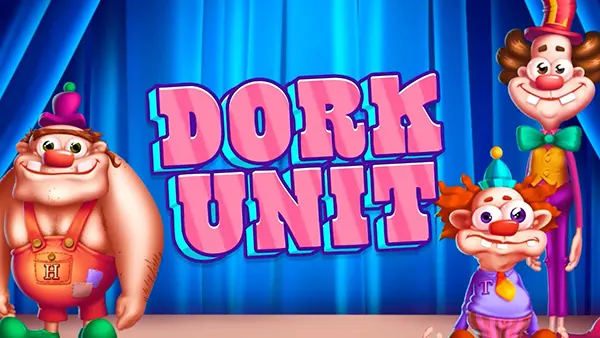
Dork Unit by Hacksaw Gaming: features, maths, and the real-world risks
Dork Unit is a clown-themed 5×4 video slot from Hacksaw Gaming, first released on 26 July 2022. It looks light-hearted, but the design is very “Hacksaw”: most meaningful payouts come from multiplier behaviour inside the two main bonus features, not from the base game alone. If you’re assessing it in 2026, it’s worth separating what the game can do on paper (RTP range, maximum win, feature structure) from what it often does in practice (small hits, swingy sessions, and expensive feature access).
Core setup: grid, paylines, RTP range, and what that implies
Dork Unit uses a 5-reel, 4-row layout with 16 fixed paylines. Stakes typically run from 0.10 up to 100 per spin (currency depends on the casino), so it’s built to accommodate low-stake testing as well as higher-stake play. The maximum win is commonly listed at 10,000× your bet, which is substantial, but also a clue: the game is engineered so that “ceiling” results sit far out on the distribution, rather than arriving as frequent medium-sized wins.
On RTP, published figures you’ll see most often are around 96.24%–96.28%, and many listings also note that the RTP can be configurable (meaning different casinos may run different RTP settings). In practical terms, “RTP can vary” is not a technical footnote — it affects long-run value. If you can’t find the exact RTP setting in the game’s info/help screen, you’re making a decision with missing information.
Volatility is widely rated in the medium bracket (often shown as 3/5), but that label can be misleading if you interpret it as “gentle”. In this title, medium volatility often means a steady stream of small offsets (mini wins and occasional multipliers) plus occasional sharp swings when bonus features line up. A sensible way to read it: you may see wins regularly, but the wins that matter usually depend on feature timing and multiplier stacking.
Symbols and base-game dynamics: why the slot can feel “busy” but still drain a bankroll
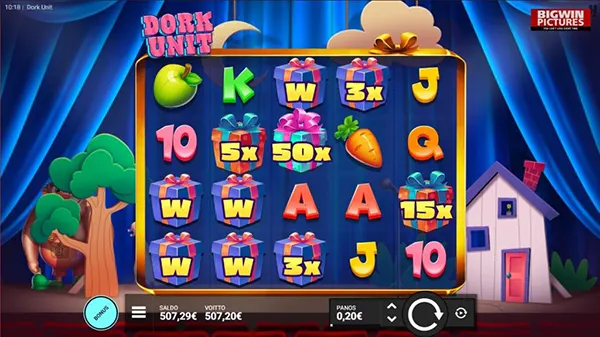
Visually, the base game leans into fruit and card icons, with character wilds and Gift Boxes acting as the real drivers. Many base-game line wins are modest, so a session can look active while the balance trends downward — especially if you increase stake chasing a “proper” hit. That’s not a moral judgement, it’s simply how this maths model tends to feel when the high-impact parts don’t land.
The wild/multiplier behaviour is what keeps the base game from being flat, but it also adds variance. Multipliers can turn a small hit into something acceptable, yet you can also go long stretches where multipliers land without connecting to paying lines in a meaningful way. If you’re evaluating risk, pay attention to how often you’re getting “almost moments” that invite bigger stakes or longer sessions.
Another practical point for 2026: if you play under UK rules, your maximum stake per game cycle is capped by age band (and game speed rules apply), which limits how much you can “solve” variance by simply increasing stake. That can be a positive safeguard, but it also means chasing losses by stake escalation is less available, so players sometimes compensate by extending sessions — which is a different risk pattern, not a safer one.
Main feature 1: Gift Boxes and the Gift Bonanza (sticky respins with lives)
Gift Bonanza is one of the two headline acts. It’s commonly described as a Hold-and-Win-style respin feature with “lives”: Gift Boxes can land, remain sticky, and additional boxes can refresh the life counter, keeping the feature going. This structure can create long feature runs, but long doesn’t automatically mean profitable — the outcome depends on what multipliers and values are attached to the boxes and how they interact as the board fills.
Mechanically, the attraction is clear: a sticky/respins feature increases exposure to the high-impact symbols without requiring a free spins retrigger loop. The risk is equally clear: if the feature starts weak and fails to improve, you can burn a meaningful chunk of bankroll chasing a better version of the same feature, because the entry condition feels “close” and the rounds are easy to rationalise as “due”.
In terms of bankroll planning, Gift Bonanza often behaves like a mid-range “engine room”: it can stabilise sessions with occasional decent hits, but it can also produce underwhelming results that nudge players toward feature purchases or longer play. If you’re trying to play responsibly, it helps to decide in advance whether a mediocre Gift Bonanza result counts as an acceptable outcome for your session, rather than treating it as proof you should keep going.
Bonus buys and “FeatureSpins”: convenience versus cost (and why it changes your risk profile)
Dork Unit is widely listed as offering multiple paid feature options. Commonly cited examples include a low-cost “FeatureSpins” style option (around 3× bet) that guarantees at least one Gift Box on a spin, plus higher-cost direct buys for Gift Bonanza (often around 100×) and Dork Spins (often around 200×). Exact pricing and availability can vary by operator and jurisdiction, so the in-game help screen is the only version that truly matters at the moment you play.
From a risk perspective, feature buying changes two things at once: your variance per decision and your pace of losses. A 100× or 200× purchase can concentrate a lot of your session budget into a single outcome, which may be fine if you’ve ring-fenced that money as entertainment spend — but it’s a problem if you’re doing it reactively after a losing stretch. It also makes it easier to lose track of “time spent” because you’re skipping the slow build of the base game.
There’s also a practical regulatory angle for 2026. In the UK, slot stakes are capped by age band, and speed-of-play requirements apply to online slots. Separately, the Gambling Commission has moved to tighten rules around promotional design (for example, limiting certain complex or potentially harmful offer structures). None of that makes feature buying safe by default, but it does mean you should expect differences in how the same game is presented and what optional features are actually available depending on where you play.
Main feature 2: Dork Spins (free spins with full-reel wild “Dorks” and shifting multipliers)
Dork Spins is the second main act and is typically the feature most associated with the 10,000× headline. It’s commonly described as a free spins round (often 10 spins) where “Dork” reels can appear as stacked or full-reel wilds carrying multipliers that can change across spins. The appeal is straightforward: when multiple reels convert into high-multiplier wilds at the same time, the game can produce outsized line wins.
The risk, again, is how rare those alignments can be. A free spins round can look lively — reels transforming, characters appearing, multipliers changing — while delivering only modest returns if the timing and reel combinations don’t line up. Players often remember the best-looking spin rather than the net result, which is how a feature can feel “good” but still be negative value in a session.
If you want a grounded way to assess Dork Spins, treat it like a distribution problem rather than a highlight reel. Ask yourself: how many rounds can you realistically afford at your chosen stake (or buy price) before you hit a personal stop point? If the answer is “not many”, your experience will be dominated by variance, and the 10,000× headline becomes psychologically dangerous — it encourages expectation where only possibility exists.
2026 risk checklist: session control, UK limits, and avoiding the usual traps
Start with two limits that you control: a money cap and a time cap. In this game, time limits matter because you can rack up many small wins that extend play without meaningfully improving your position. A simple rule works well: once you hit your time cap, stop even if you feel “close” to a bonus — closeness is part of the design, not a signal.
If you play under UK regulation, remember the statutory stake limits for online slots: £5 per game cycle for customers aged 25+ and £2 for customers aged 18–24, alongside game-speed rules that enforce a minimum cycle time. These measures reduce the harm potential of high-stake rapid-fire play, but they do not prevent overspending through longer sessions, repeated feature purchases, or chasing behaviour.
Finally, be honest about what triggers you. Dork Unit is built around “nearly there” moments: partial bonus setups, multipliers that don’t connect, and features that can be bought after a dry run. If you notice yourself changing stake, extending sessions, or switching to feature buys because you feel annoyed rather than entertained, that’s the clearest signal to stop — not because the game is “bad”, but because your risk profile has shifted.